Product & The Long Tail
AI is quickly changing the product world. The focus of change however has not been where it should be in my eyes: on enabling the user to solve their specific problems.
The old paradigm
Pre-AI, Products at scaled SaaS companies were built roughly like this:
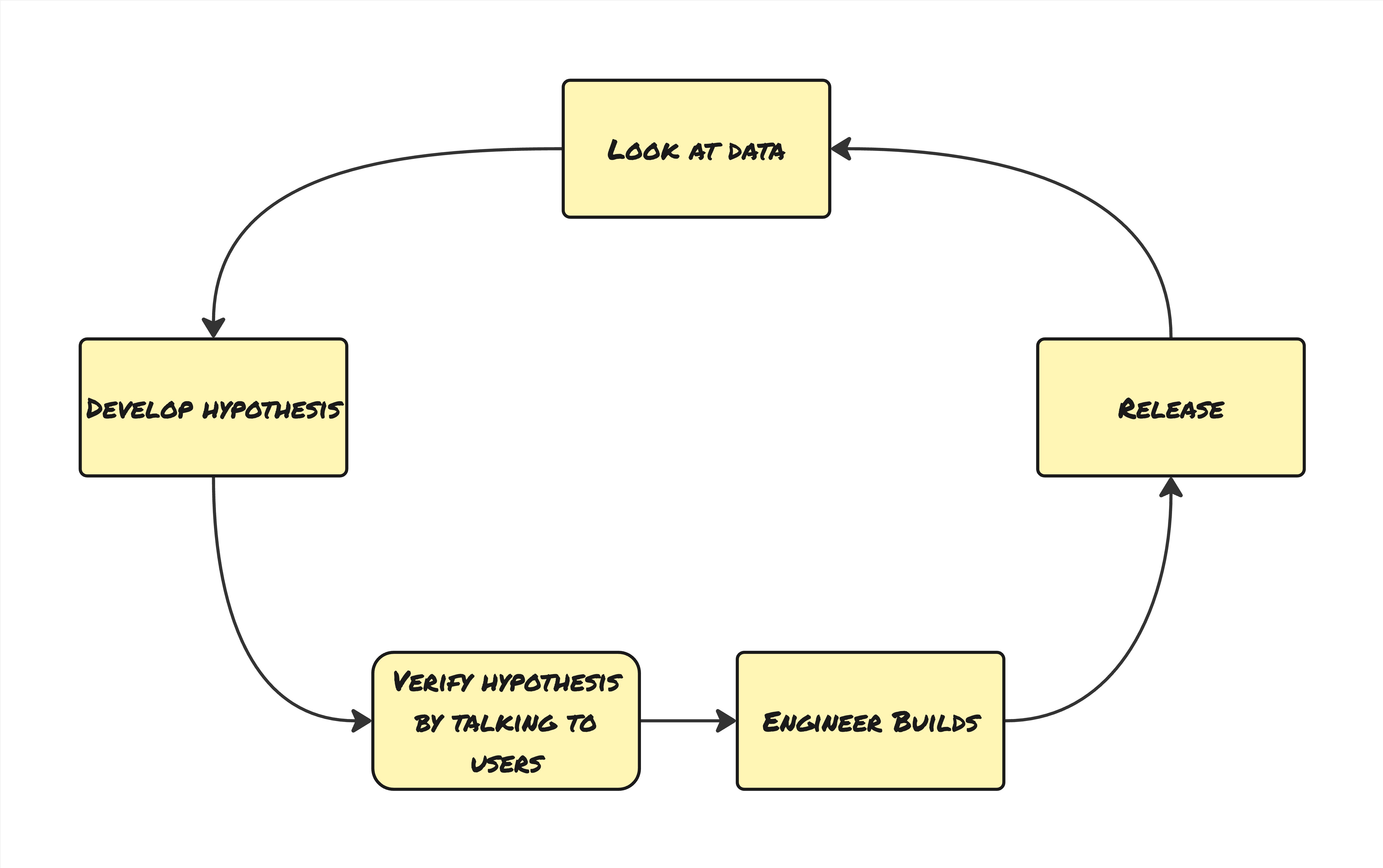
This process introduced various bottlenecks. Since engineers building certain cost a lot of time and money, ideas had to be filtered excessively such that only the highest value opportunities were pursued. This in turn meant that product teams at scaled companies were focussed on those opportunities that the largest number of customers would pay for. Only the needs of large niches could be addressed economically with SaaS. Within this scope, these businesses often operated efficently while covering all edge cases that engineers of specialized solutions could often not afford to address.
The new AI paradigm
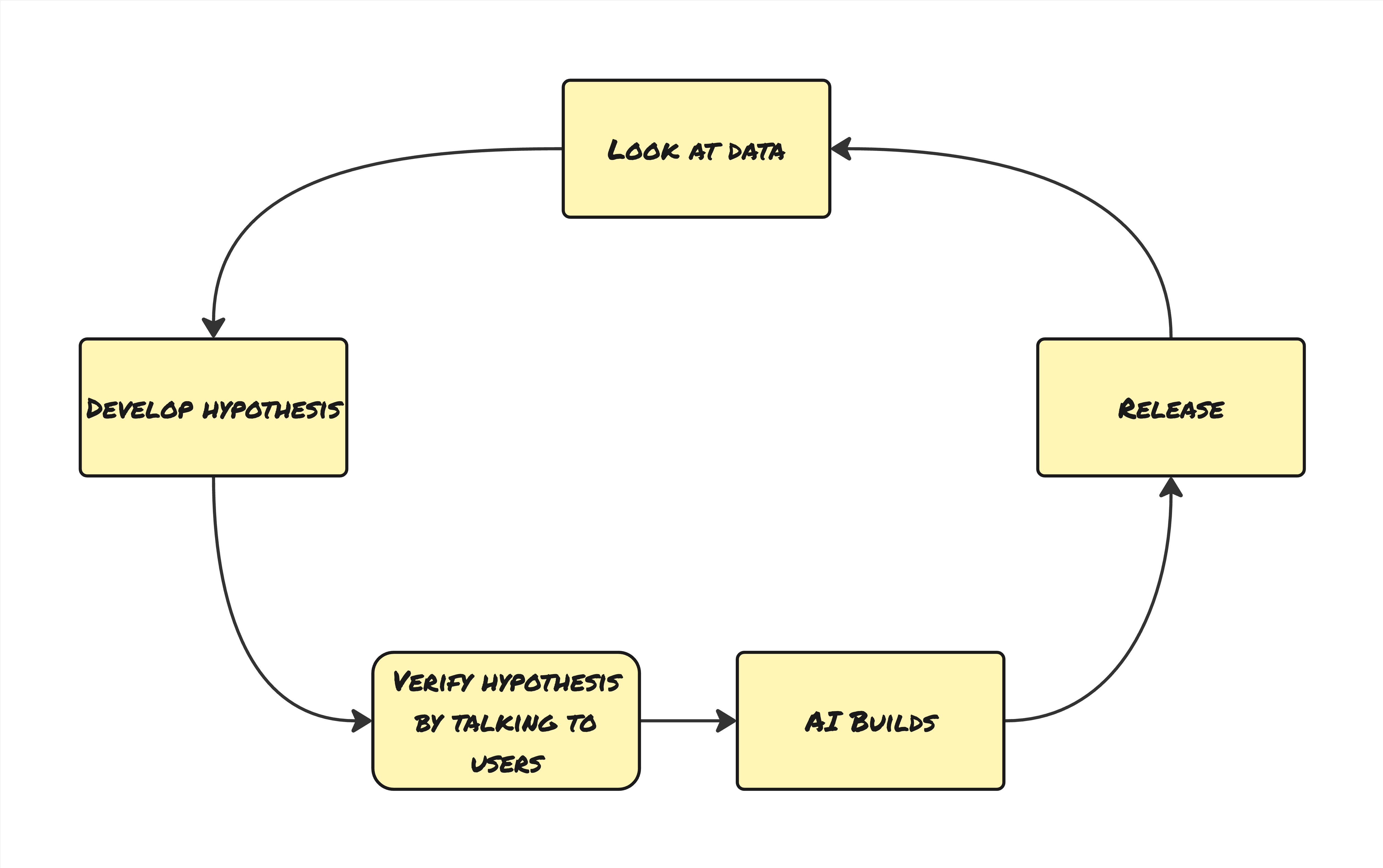
With the new AI paradigm, the promise is that AI engineers can dramatically reduce the marginal cost of building solutions, increasing the number of opportunities that can be addressed. However, the fundamental bottleneck does not get removed, we are just improving the throughput. Ideas are still mostly generated and tested manually by PMs, designers, and engineers, even if they can be prototyped faster. Nevertheless, by increasing the throughput, it has become economically possible to serve the needs of smaller niches.
The Long Tail paradigm
A long time ago, before we had scaled operating systems or the internet, software was written to solve problems of individual users or customers. It was prohibitively expensive, but it catered to these needs perfectly. These days, it would be much simpler to build a comparable solution using tools like Cursor or Lovable, but the cost of maintenance is still high, which means that for companies, it still often makes sense to buy rather than build when it comes to software that isn’t addressing the company’s core mission. You have to trade off maintainability and customizability, which again leads to software that is not being tailored for individual use cases.
Ideally, however, we would like to return to the world of individualized software while being free of its high costs. We would finally have software that does not ignore the long tail of problems that our messy reality creates for us. I think this is becoming possible.
Taking the SaaS approach of spreading out the cost of edge cases within the general domain scope across the user base and combining it with a Lovable-like approach of letting the end user build for their own specialized needs all within one product is where SaaS should go in the next 5 years. SaaS companies would build and maintain a core product and let users build on top of it dynamically using AI.
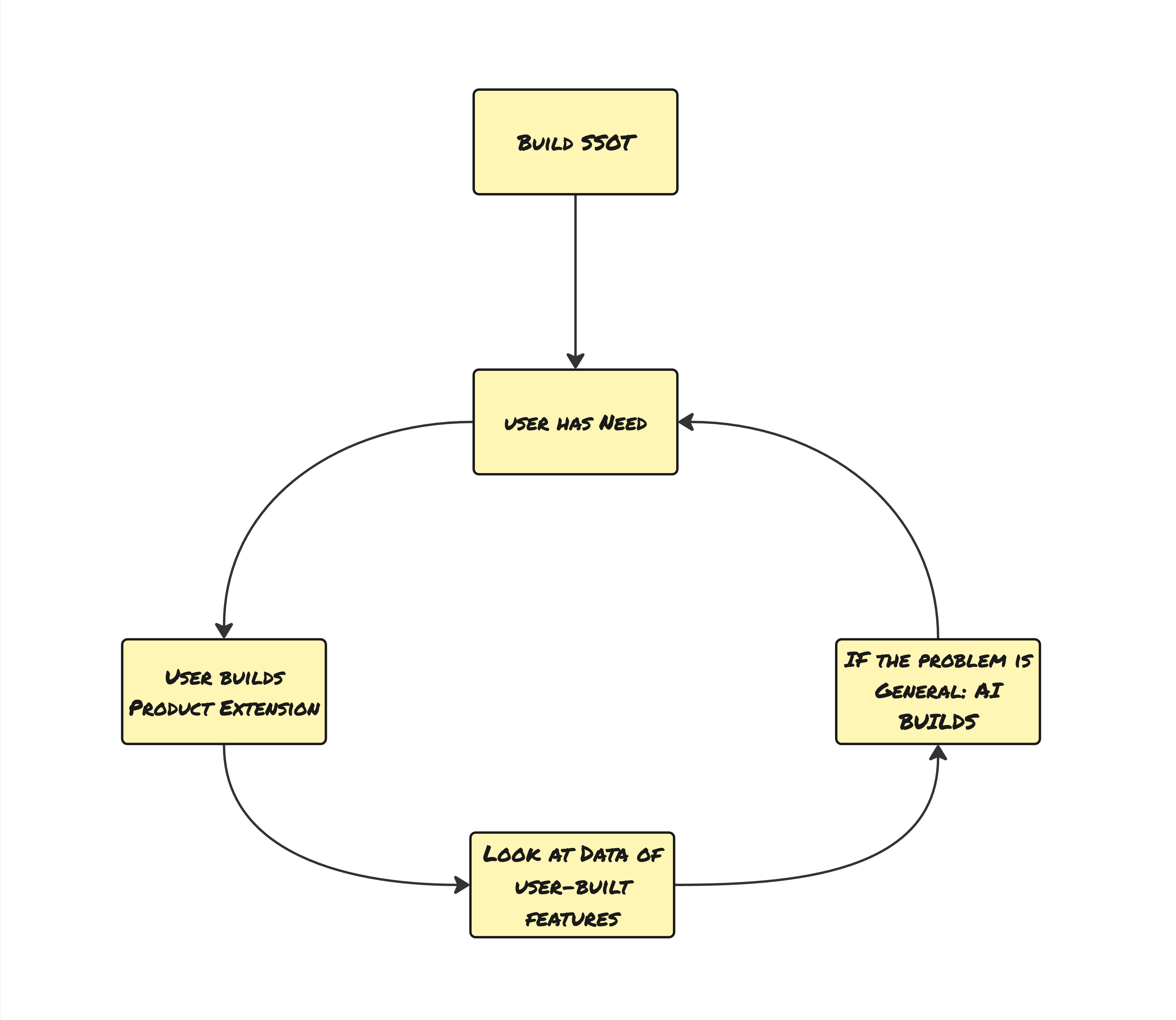
For more involved use cases, this may seem scary given the capabilities of the current models. Yet one area that is already ripe for this kind of model is analytics. Any SaaS that stores and operates on a single source of truth (SSOT) currently has to provide analytics to their users. Analytics really isn’t core business for these companies because few of their customers will make a buying decision based on the quality of their analytics platform, but if there isn’t one, you will lose customers. This means lots of companies have expensive analytics teams shipping half-baked solutions that are constantly outdated as users keep coming up with more and more questions for which there is not enough capacity to build answers.
Why should there be such teams chasing all these data requests and trying to generalize them, when each end user could just build their own report using AI? Whoever can build a company that abstracts this capability and provides it to your local SaaS will build a generational company.